

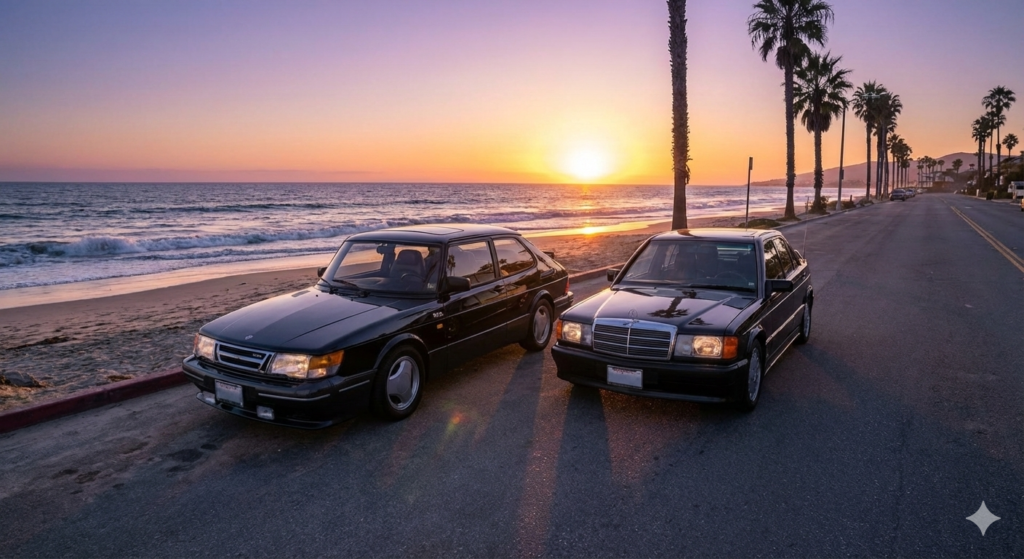
A deserted coastal road, the sun dipping below the horizon, and two of the most sinister black sport sedans of the decade. Which one would you drive home?
Take a look at the image above. No, seriously, look again. If you’re a true «petrolhead,» that sight probably gets your heart racing faster than a triple espresso. We’ve got the perfect coastal road, the golden light of sunset, and two legends parked on the shoulder: a Saab 900 Turbo (featuring the coveted Airflow kit) and a Mercedes-Benz 190E 2.3-16 (the legendary Cosworth).
Both are black, both are fast, and both were born in an era where engineers had more power than marketing departments. But that’s where the similarities end. One is an exercise in Scandinavian eccentricity born from aeronautics; the other is a precision German machine built to dominate the DTM.
Today, we dive into these two gems with a bit of humor, nostalgia, and history.
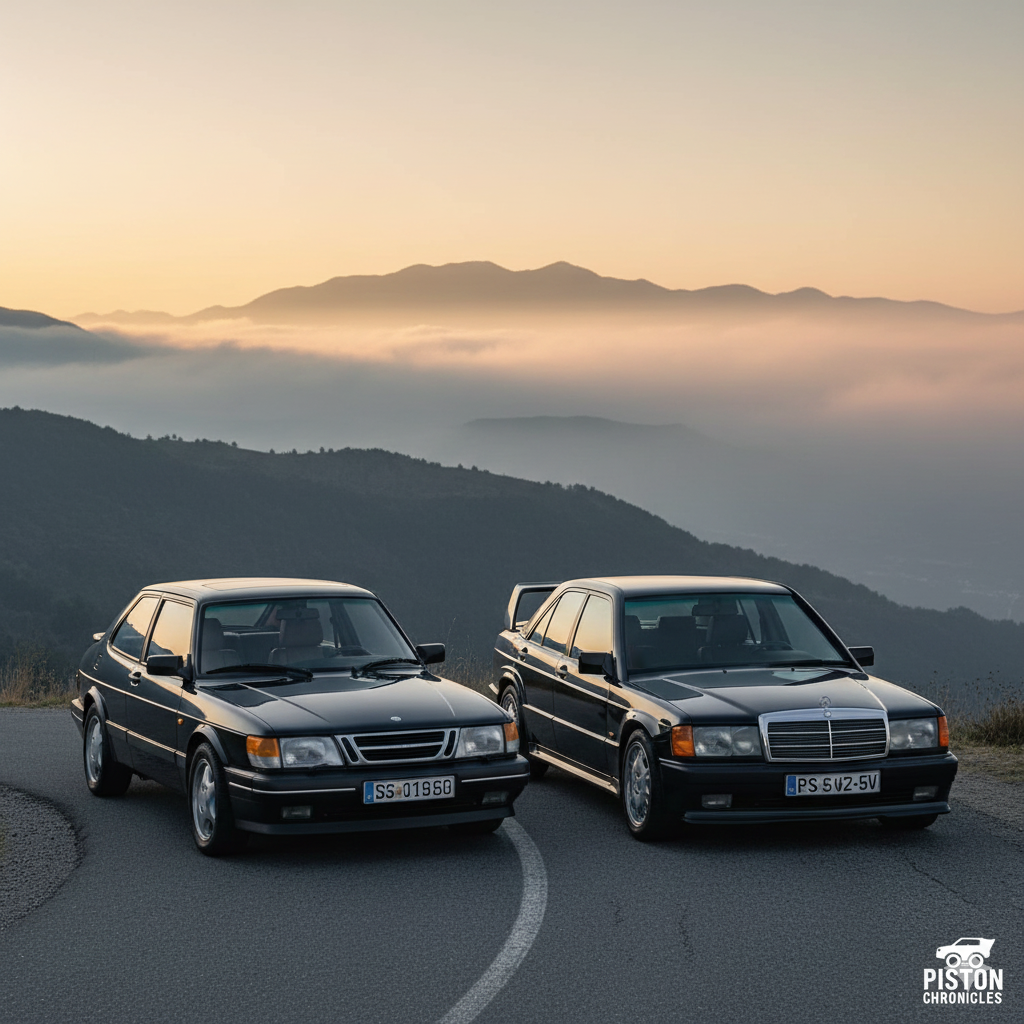
The Swedish Fighter Jet: Saab 900 Turbo (Airflow Edition)
If the Saab 900 were a person, he’d be that eccentric architect uncle who wears weird designer glasses, only dresses in black, and explains why his Swedish-designed chair is superior to any sofa—even if it’s slightly uncomfortable.
Saab always played the «Born from Jets» card. While for the 900 Turbo that was mostly marketing, the car itself was… well, weird. Weird in a good way. The curved cockpit-style windshield, the ignition key located between the seats (to avoid shattering your kneecap in an accident, the Swedes claimed), and an engine mounted backwards.
The Story: «Viking Engineering and the Impossible Clutch»
The funniest (or most tragic, depending on if you’re the mechanic) story about the classic Saab 900 is its mechanical layout. It’s a front-wheel-drive car, but the engine is mounted longitudinally and tilted at 45 degrees. The twist? To get power to the front wheels, the engine was installed backwards.
The timing chains were pressed against the cabin firewall (a nightmare to service), and the clutch was at the front of the car, right behind the radiator. The upside? You could change the clutch in 45 minutes without removing the engine or gearbox. The downside? For almost anything else, you practically had to take the car apart. It was a brilliant and ridiculously complicated solution. Truly Saab.
SAAB 900 TURBO: PROS & CONS
| PROS (Why you love it) | CONS (Why you’ll cry) |
| Unique Character: Nothing else looks or sounds like it. | Biblical Turbo Lag: You floor it on Tuesday; the power arrives on Thursday. |
| Practicality: That massive hatchback trunk is basically a cave. | The Gearbox: It’s made of glass. If you push it too hard, it will break. |
| «Airflow» Aesthetics: With that body kit, it looks like it’s straight out of Blade Runner. | Eccentric Mechanics: Requires a mechanic who speaks «Swedish engineering.» |
| Comfort: Saab seats are legendary—perfect for crossing continents. | Torque Steer: Under hard acceleration, the wheel will try to rip your arms off. |
The Precision Hammer: Mercedes-Benz 190E 2.3-16
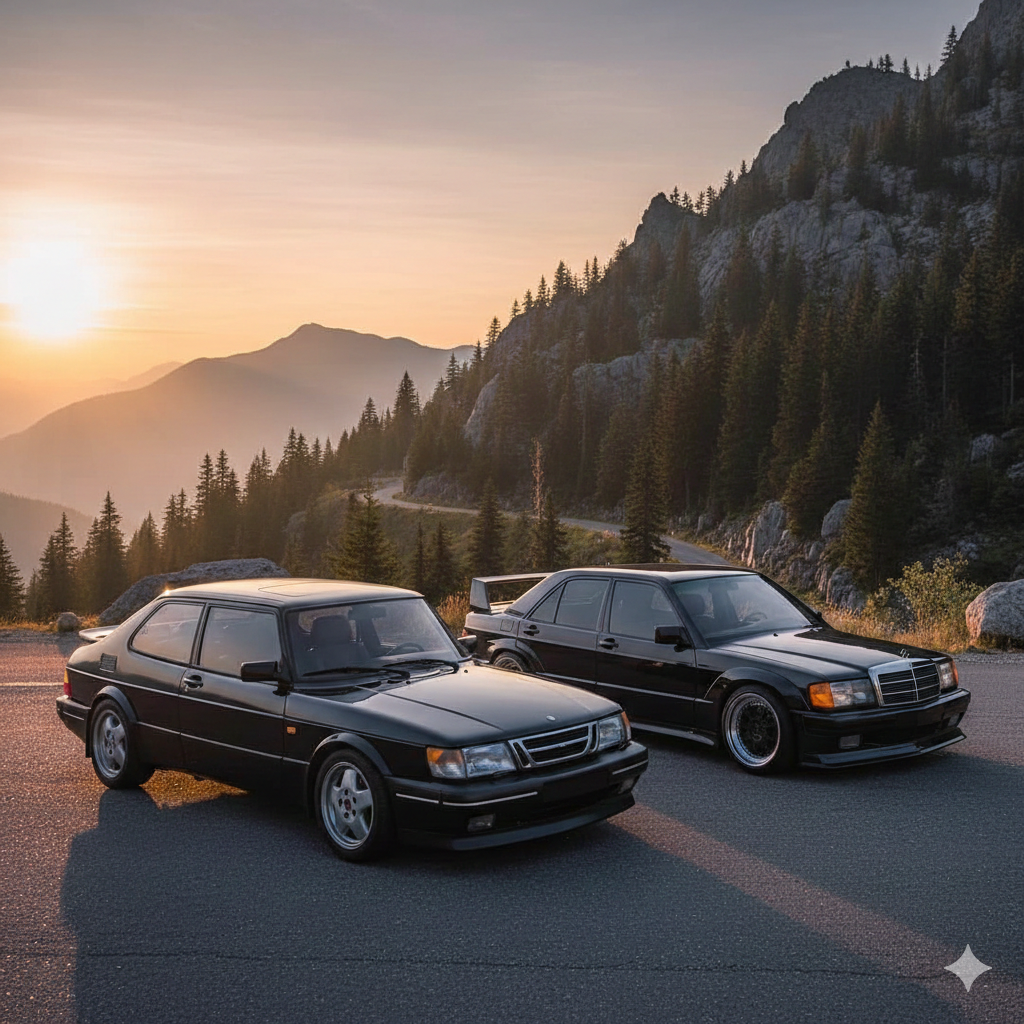
If the Saab is the eccentric architect, the Mercedes 190E 2.3-16 is the German surgeon operating to classical music without a single wrinkle in his suit. This car wasn’t born «weird»; it was born with one purpose: to win races.
Mercedes originally wanted to go rallying (yes, rallying!) and asked the British wizards at Cosworth to develop a 16-valve head for their reliable but boring M102 engine. Cosworth worked their magic, producing 185 hp that screamed all the way to 7,000 RPM. But then Audi showed up with the Quattro and ruined the rally party. Mercedes’ solution? Pivot to the DTM (German Touring Car Championship). The rest is history.
The Story: «The Day a Rookie Named Senna Humiliated the Champions»
This is perhaps the greatest accidental marketing story in history. In 1984, to inaugurate the new Nürburgring GP circuit, Mercedes organized a «Race of Champions.» They invited F1 legends like Niki Lauda, James Hunt, and Alain Prost, giving them all identical, factory-fresh 190E 2.3-16s.
At the last minute, Emerson Fittipaldi canceled. To fill the gap, they invited a skinny young Brazilian who had just arrived in F1: Ayrton Senna.
The result? Senna drove like a man possessed. He overtook Prost in the first corner, pushed Lauda off the pace, and won the race with a staggering lead against the world’s best drivers. That day, the world learned who Senna was, and the 190E 2.3-16 earned its reputation as an instant «giant killer.»
MERCEDES 190E 2.3-16: PROS & CONS
| PROS (Why you love it) | CONS (Why you’ll cry) |
| The Chassis: The revolutionary multi-link rear axle offers sublime balance. | Cosworth Pricing: Break an engine part and prepare to mortgage your house. |
| «Dog-Leg» Gearbox: First gear is down and to the left. Pure racing pedigree. | Subtle Styling: It’s less «in your face» than its arch-rival, the BMW M3 E30. |
| Build Quality: Built like a tank. It feels carved out of a single block of granite. | Hydraulic Suspension: The self-leveling rear system is great until it leaks. |
| Racing Heritage: Driving it connects you directly to the golden era of DTM. | Rust: Despite being solid, they love to rust under the plastic body kits. |
Conclusion: Which One Takes the Crown?
Back to that sunset on the coast. You have the keys to both in your hand.
If you choose the Saab 900 Turbo, you choose adventure, quirkiness, and the whistle of the turbo. It’s a statement of individualism.
If you choose the Mercedes 190E 2.3-16, you choose a precision tool. A car that makes you a better driver and rewards you for chasing the redline.
Honestly? There is no wrong answer. Just make sure you reach the end of the road before the sun disappears.